
Constant Voltage LED Drivers: Architecture, Applications, and Selection Guide
What Makes a Driver Constant-Voltage?
A constant-voltage (CV) LED driver maintains a fixed DC output voltage regardless of the load current, within its rated power limits. The most common output voltages are 12V DC and 24V DC, though 36V and 48V variants exist for higher-power installations. The driver's output current varies automatically based on the connected load: a 24V, 100W driver will supply up to 4.17A at full load, but if only a 25W strip is connected, it delivers approximately 1.04A while holding the output at a steady 24V.
This behavior stands in contrast to a constant-current (CC) driver, which fixes the output current and allows the voltage to vary within a specified range. The distinction is not arbitrary—it reflects the electrical characteristics of the LED loads each topology is designed to serve.
The Electrical Case for Constant Voltage
LEDs are inherently current-driven devices. The luminous output of an LED is approximately proportional to its forward current, and exceeding the rated current accelerates lumen depreciation and can cause catastrophic failure. So why use a constant-voltage driver?
The answer lies in how certain LED products are constructed. Flexible LED strips, rigid light bars, and many signage modules are built with multiple LEDs connected in parallel strings, each string containing a series resistor or a simple current-limiting circuit. These products are designed to operate at a fixed voltage—typically 12V or 24V—and the on-board resistors handle current regulation for each parallel branch. When you apply the rated voltage, each branch draws its designed current, and the total current is simply the sum of all branches.
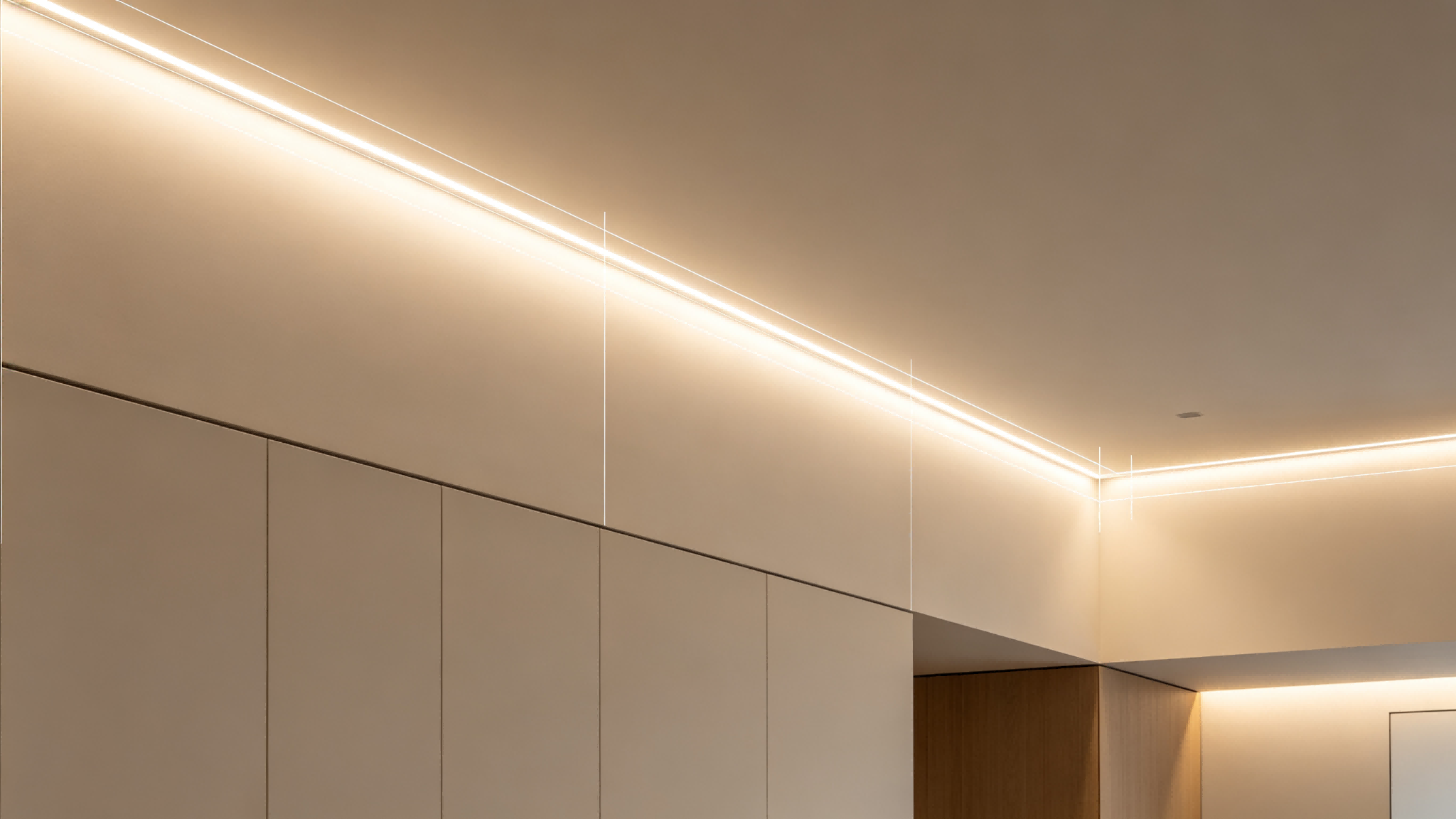
This arrangement offers a decisive practical advantage: the installer can cut the strip to length, connect multiple strips in parallel, or mix and match modules, and the driver automatically supplies whatever current is needed—up to its maximum rating. No calculation of series voltage drops is required, and adding or removing fixtures does not demand a different driver. This flexibility makes constant-voltage systems the standard for cove lighting, under-cabinet lighting, backlighting, and decorative applications where the exact load may not be known in advance.
Inside a Constant-Voltage LED Driver
A typical isolated constant-voltage LED driver follows a flyback or buck-boost converter topology. The AC input passes through an EMI filter and a bridge rectifier, producing a high-voltage DC bus. A switching transistor chops this DC at high frequency—usually between 50 kHz and 150 kHz—and feeds the primary winding of a high-frequency transformer. The secondary winding delivers a lower AC voltage, which is rectified and filtered to produce the regulated DC output.
An optocoupler provides isolated feedback from the output to the primary-side controller, closing the voltage regulation loop. The controller adjusts the duty cycle of the switching transistor to maintain the target output voltage under varying line and load conditions.
In a TRIAC-dimmable constant-voltage driver, additional circuitry is required. The phase-cut AC waveform from the dimmer must be interpreted to determine the desired dimming level, and the driver must maintain stable operation as the input RMS voltage varies. This typically involves a dedicated dimmer interface circuit that detects the firing angle, an active bleeder to sustain TRIAC holding current, and a control loop that translates the firing angle into an appropriate output voltage or PWM dimming signal.
Constant Voltage vs. Constant Current: Making the Right Choice
The selection between CV and CC drivers should be guided by the LED load, not by personal preference or cost alone.
Constant-voltage drivers are the correct choice when the LED product explicitly specifies a fixed operating voltage. This includes nearly all flexible LED strips, LED neon rope, many cabinet and display lighting products, and signage systems. In these applications, the current regulation is handled by resistors or linear regulators on the LED module itself, and the driver's job is simply to provide a clean, stable voltage rail.
Constant-current drivers are required when the LEDs are wired in a long series string with no on-board current limiting. This is the standard configuration for high-power downlights, panel lights, streetlights, and floodlights, where a single string of LEDs may require 300mA, 700mA, or 1.05A at a forward voltage that varies with the number of LEDs in the string. A CC driver ensures that every LED in the string receives exactly the same current, guaranteeing uniform brightness and preventing thermal runaway.
Key Specifications for Selection
When selecting a constant-voltage LED driver, several specifications demand careful attention.
Output voltage must match the LED product's rated voltage exactly. A 24V strip connected to a 12V driver will be dim and may not light at all; a 12V strip connected to a 24V driver will be destroyed almost instantly.
Maximum output power must exceed the total connected load. A common rule of thumb is to size the driver at 120% of the calculated load, providing headroom for inrush current and ambient temperature derating. Running a driver at 100% load continuously shortens its lifespan, primarily by accelerating the degradation of the output electrolytic capacitors.
Efficiency directly affects both energy consumption and heat generation. A quality 24V constant-voltage driver should achieve 85% to 90% efficiency at full load. Power factor correction (PFC) is increasingly important, especially in commercial installations; a driver with active PFC achieves a power factor of 0.95 or higher, reducing reactive current draw and helping facilities meet energy codes.
Isolation rating determines whether the driver can be installed in contact with the LED load without additional safety barriers. A Class II (double-insulated) driver requires no ground connection and is suitable for plastic-encased LED products. Protection features—over-voltage, over-current, short-circuit, and over-temperature protection—are standard in reputable drivers but vary in their response behavior. Hiccup-mode short-circuit protection, which automatically recovers when the fault is removed, is preferable to latch-off protection in unattended installations.
The Role of the Enclosure
For indoor constant-voltage drivers, plastic enclosures are common. They are lightweight, non-conductive, and cost-effective, and they can be molded to provide integrated mounting features and cable strain relief. The thermal performance of a plastic enclosure is inherently lower than that of a metal case, so the driver's internal heat dissipation must be carefully managed through PCB layout, component placement, and the use of thermally conductive pads where needed.
IP20 is the typical ingress protection rating for indoor plastic-enclosed drivers, meaning they are protected against fingers and objects larger than 12.5mm but offer no water protection. These drivers are intended for installation in dry, ventilated locations such as ceiling cavities, junction boxes, or dedicated driver enclosures.
Constant-voltage LED drivers may not be as glamorous as the luminaires they power, but they are the foundation upon which reliable, high-performance LED lighting is built. Understanding their architecture, matching them correctly to the load, and specifying quality products from reputable manufacturers is the surest way to ensure that an LED installation delivers years of trouble-free service.
Achieving Flicker-Free Dimming: The Science Behind Smooth LED Light Control
Understanding Triac Dimming for LED Lighting: Principles, Challenges, and Best Practices
Related Article